


Everything about LEDs: Learn the basics of LED lighting and how to power!
Date:
2025-02-12
LEDs are appropriate for many lighting applications, they are designed to produce a lot of light from a small form factor while maintaining fantastic efficiency. Here at LEDSupply, there are a variety of LEDs for all kinds of different lighting applications, the trick is knowing how to use them. LED technology is a tad different than other lighting that most people are familiar with. This post is here to explain everything you need to know about LED lighting: how to power LEDs safely so you get the most light and the longest lifetime possible.
What Exactly is an LED?
light emitting diode schematic
An LED is a type of diode that turns electrical energy into light. For those that don’t know, a diode is an electrical component that only works in one direction. Basically, an LED is an electrical component that emits light when electricity flows through in one direction, from the Anode (positive side) to the Cathode (negative side). LED is an acronym standing for ‘Light Emitting Diode’. Basically, LEDs are like tiny light bulbs, they just require a lot less power to light up and are much more efficient in producing high light outputs.
LED Types
In general terms, we carry two different types of LEDs:
5mm Through-Hole & Surface Mount.
5mm LEDs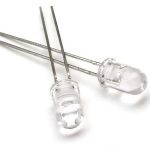
5mm LED
5mm LEDs are diodes inside a 5mm diameter lens with two thin metal legs on the bottom. They are used in applications where a lower amount of light is required. 5mm LEDs also run at much lower drive currents, maxing out at around 30mA, whereas Surface Mount LEDs require a minimum of 350mA. All our 5mm LEDs are from top manufacturers and are available in a variety of colors, intensities, and illumination patterns. Through-hole LEDs are great for small flashlight applications, signage, and anything where you are using a breadboard as they can be used easily with their leads. Check out our guide to setting up 5mm LEDs for more info on these tiny light sources.
Surface Mount LEDs (SMD)
light emitting diode bare emitter
Figure 1 – Bare Emitter
Surface Mount LEDs are diode(s) that can be placed on a substrate (circuit board) with a silicon dome over the diode to protect it (see Fig. 1). We carry high-power Surface Mount LEDs from industry leaders Cree and Luxeon. Both are excellent in our opinion, that is why we carry them after all. Some prefer one over the other but that comes with experience and knowing what to look for. Cree tends to have higher listed Lumen outputs and is a market leader in the High-Power LED sector. Luxeon, on the other hand, has excellent colors and thermal control.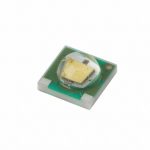
High Power LEDs come as bare emitters (as seen in Fig. 1) or are mounted to a Metal Core Printed Circuit Board (MCPCB). The boards are insulated and contain conductive tracks for easy circuit connections. Our 20mm 1-Up and 3-Up starboard designs are the best sellers. We also offer QuadPod’s which can hold 4 high-power LEDs on a board slightly larger than the 20mm stars (see Fig. 2). All our high-power LED options can be built on a linear design as well. The LuxStrip can house 6 LEDs per foot and is easily connected up to 10 feet long.
LED Star MCPCB configurations
Figure 2 – MCPCB Options
Polarity Matters: Wiring LEDs
Electronic polarity indicates whether a circuit is symmetric or not. LEDs are diodes, therefore only allowing current to flow in one direction. When there is no current flow, there will be no light. Thankfully this means that if we wire an LED in backward, it will not burn the whole system up, it just won’t come on.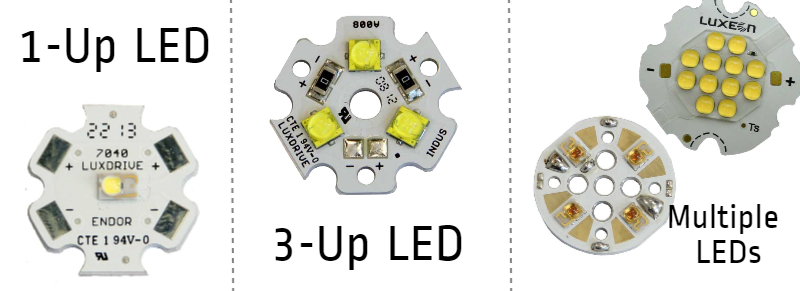
The positive side of the LED is the Anode and the negative side is the Cathode. Current flows from the anode to the cathode and never in the other direction, so it is important to know how to tell the anode and cathode apart. For surface mount LEDs this is easy as the connections are labeled, but for 5mm LEDs ook for the longer lead which is the anode (positive), take a look at Figure 3 below.
Polarity of LED explained
Figure 3 – Finding the anode and cathode of an LED
Color Options
One of the great things about LEDs is the different options and kinds of light you can get from them.
White LEDs
Correlated Color Temperature (CCT) is the process of creating different white light at different temperatures. Color temperature is specified in degrees Kelvin (K), which is a temperature scale in which zero occurs at absolute zero and each degree equals one Kelvin. The lower temperatures from 3,000K to 4,500K tend to be warmer to neutral white. The higher temps 5,000K+ are the cool whites, also known as ‘daylight white’.
Color LEDs
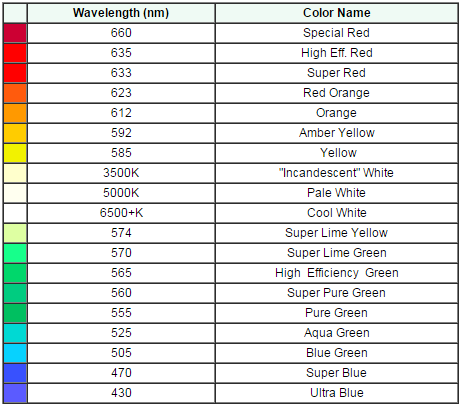
For colors, what really matters is the wavelength in nanometers (nm). For certain applications, colors are needed for the visual effect, but sometimes certain wavelengths are needed for applications like curing, growing, reef tank lighting, and much more. See Fig. 4 for an idea of what wavelengths and temperatures produce certain colors.
5mm LEDs, SMD LEDs
Info.Recommendation

2024.10.28



Sales Hotline
Address: 6th Floor, Building E, Huachuangda Industrial Park, Gushu Hangcheng Avenue, Xixiang, Baoan District, Shenzhen, Guangdong.
Product Message
WeChat consulting