


Introduction to LED Lighting
Date:
2024-07-01
Introduction to LED Lighting
LEDs are versatile and efficient lighting solutions that produce significant light from a small form factor. Here, we'll cover the essentials of LED lighting, from understanding what LEDs are to exploring different types and applications.

What Exactly is an LED?
An LED, or Light Emitting Diode, is an electronic component that emits light when an electrical current flows through it in one direction, from the anode (positive side) to the cathode (negative side). Unlike traditional light bulbs, LEDs are more efficient, requiring less power to produce the same amount of light.
LED Types
There are two primary types of LEDs:
5mm Through-Hole LEDs
Surface Mount LEDs (SMD)
5mm Through-Hole LEDs
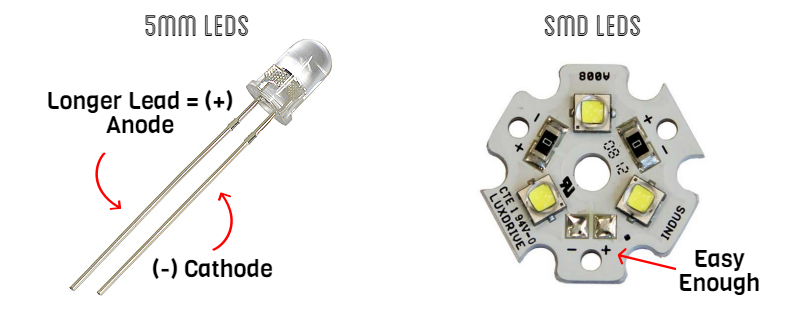
These LEDs have a 5mm diameter lens and two metal legs. They operate at lower currents (up to 30mA) and are suitable for applications needing less light, such as small flashlights and signage.
Surface Mount LEDs (SMD)
These LEDs are placed on a circuit board with a protective silicon dome. High-power SMD LEDs, like those from Cree and Luxeon, are known for their high light output and thermal management. They come as bare emitters or mounted on a Metal Core Printed Circuit Board (MCPCB), which simplifies circuit connections.
Polarity Matters: Wiring LEDs
LEDs only allow current to flow in one direction, from the anode to the cathode. Wiring an LED incorrectly won't damage it; it just won't light up. For 5mm LEDs, the longer lead is the anode (positive).
Color Options
LEDs come in various colors and white light temperatures.
White LEDs
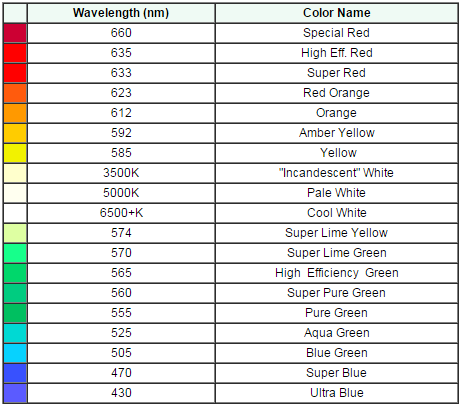
Color temperature, measured in Kelvin (K), ranges from warm (3000K) to cool (5000K+).
Color LEDs
The wavelength in nanometers (nm) determines the color. For example, wavelengths around 400-660nm cover most visible colors.
LED Brightness
Brightness is measured in Lumens, indicating the total visible light emitted. The drive current (measured in mA or A) affects the brightness: higher currents produce more light.
Determining LED Brightness
To determine an LED's brightness, refer to its datasheet for flux characteristics. For example, a Cree XP-L LED driven at 2100mA produces about 805 Lumens, considering a 75% increase in light output from its base measurement at 1050mA.
Viewing Angle and Optics
LEDs have specific viewing angles. Surface mount LEDs typically have a wide angle (125 degrees), but secondary optics can focus the light into different patterns, such as spot or wide spot.
Conclusion
Understanding these basics of LED lighting will help you select and use LEDs effectively, ensuring you get the most light and longest lifespan from your LED installations.
LED,LED light,LED lighting,5mmLEDS,5mm Through-Hole LEDs
Info.Recommendation



Sales Hotline
Address: 6th Floor, Building E, Huachuangda Industrial Park, Gushu Hangcheng Avenue, Xixiang, Baoan District, Shenzhen, Guangdong.
Product Message
WeChat consulting