


Introduction to RGB LEDs
Date:
2025-09-26
RGB LED
Summary of Your Points:
-
Function: An RGB LED combines Red, Green, and Blue light to create a wide spectrum of colors.
-
Limitation: It can struggle to produce accurate shades of pink and brown.
-
Physical Structure: It has four legs (one for each color and a common fourth leg).
-
Leg Identification: The longest leg is the common one (anode or cathode) and is the second from the left when the LED is facing you.
-

RGB stands for red, green, and blue. An RGB LED essentially combines three individual LEDs of these colors into a single unit. By blending these colors, it can produce a wide range of hues, though it may struggle with certain shades like pink and brown.
An RGB LED has four legs: one for each color and a common fourth leg that serves as either a common anode or common cathode. To identify the pins correctly, position the LED so that the second leg from the left is the longest. The pin order from left to right will then be: red, common (anode or cathode), green, and blue.
How an RGB LED Works

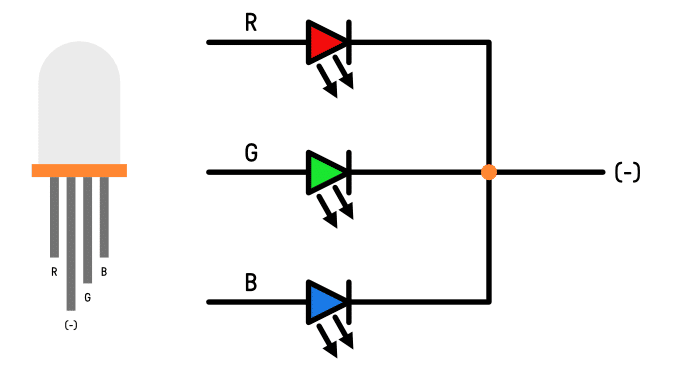
The red, green, and blue legs are all connected internally to the common leg (the second one). Depending on whether the LED is common anode or common cathode, the wiring and signaling differ:
-
If it’s a common anode type, connect the common leg to the positive terminal of the power supply. A low signal must be applied to the red, green, or blue legs to light the corresponding color.
-
If it’s a common cathode type, connect the common leg to the negative terminal. In this case, a high signal is required on the color legs to activate them.
RGB LED,led diode
Info.Recommendation



Sales Hotline
Address: 6th Floor, Building E, Huachuangda Industrial Park, Gushu Hangcheng Avenue, Xixiang, Baoan District, Shenzhen, Guangdong.
Product Message
WeChat consulting