


The difference between 365nm and 395nm violet LEDs
Date:
2025-02-14
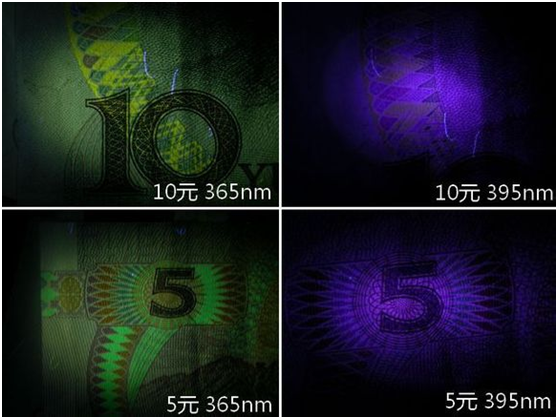
The practical differences between 365nm and 395nm purple light beads can be summarized as follows:
-
-
Color Perception:
-
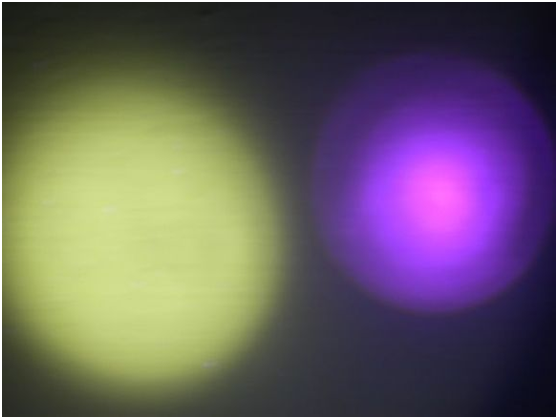
365nm: The light emitted by 365nm lamp beads is nearly invisible to the naked eye and does not appear purple. This makes it easier to observe fluorescence without the interference of visible purple light.
-
395nm: The light emitted by 395nm led diode has a strong purple hue, which can sometimes interfere with the observation of fluorescence due to the visible purple light.
-
-
Fluorescence Intensity:
-
365nm: Generally, 365nm light produces much stronger fluorescence compared to 395nm. This makes it more effective for applications requiring high fluorescence visibility.
-
395nm: The fluorescence effect under 395nm light is weaker compared to 365nm, making it less effective for certain applications.
-
-
Fluorescence Detection:
-
365nm: Capable of exciting fluorescence in materials that 395nm cannot. For example, 365nm can reveal fluorescence on the back of Renminbi (Chinese currency) that 395nm cannot.
-
395nm: Limited in its ability to excite certain types of fluorescence, making it less versatile for some detection tasks.
-
-
Practical Application:
-
365nm: Preferred for applications where strong fluorescence is needed and where the absence of visible purple light is beneficial, such as in forensic analysis, currency verification, and certain scientific research.
-
395nm: Suitable for applications where some visible purple light is acceptable and where the fluorescence effect does not need to be as strong, such as in simple UV inspections or entertainment purposes.
-
-
In summary, while both 365nm and 395nm purple light beads are used for fluorescence detection, 365nm is generally more effective due to its stronger fluorescence excitation and minimal visible light interference. However, 395nm can still be useful in scenarios where its limitations are not a significant drawback.
LEDs, led diode ,365nm LED
Info.Recommendation



Sales Hotline
Address: 6th Floor, Building E, Huachuangda Industrial Park, Gushu Hangcheng Avenue, Xixiang, Baoan District, Shenzhen, Guangdong.
Product Message
WeChat consulting